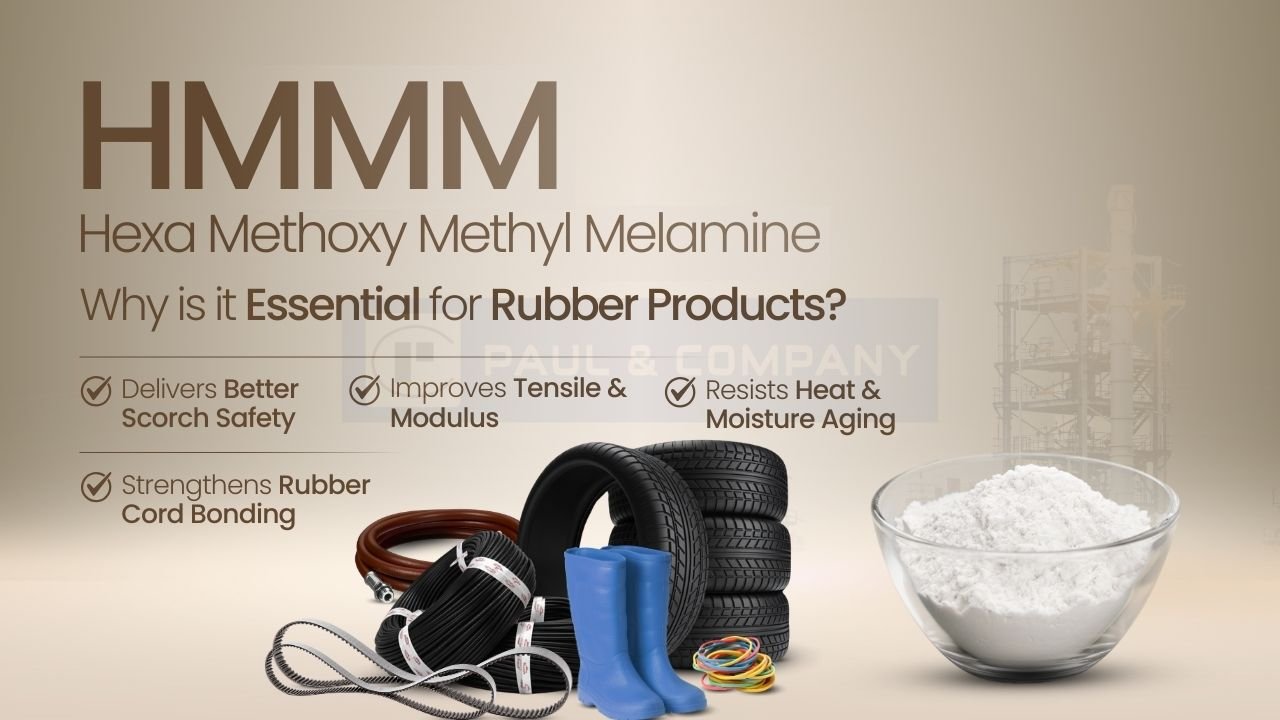
From tyres and conveyor belts to hoses and seals, durability and performance are non-negotiable in industrial rubber products.
One key ingredient is quietly making all the difference — Hexamethoxymethylmelamine (HMMM). Let’s break down why it’s a must-have in modern rubber manufacturing.
1.Built-In Bonding Power
Rubber compounds alone can struggle to maintain adhesion with steel cords, textile reinforcements, or inserts — especially under heat, humidity, or mechanical stress.
HMMM solves this by acting as a methylene donor in combination with resorcinol or RF resins, creating a strong, lasting bond between rubber and reinforcements.
 Long-term adhesion — Even after heat and moisture aging.
Higher pull-out strength — For tyres, belts, hoses, and gaskets.
Consistent quality — Across high-volume production runs.
2.Performance Under Pressure
When combined with methylene acceptors, HMMM reinforces the compound structure, leading to:
Higher tensile strength & modulus — Rubber resists stretching, tearing, and deformation.
Improved stiffness & fatigue resistance — Perfect for dynamic, load-bearing applications.
Enhanced curing control — Reduces scorch risk for safer, more efficient processing.
3.Safer & Cleaner Than HMT
HMMM is the modern alternative to Hexamethylenetetramine (HMT) — and for good reason:
Better scorch protection — Wider processing window, fewer defects.
No amine/ammonia by-products — Cleaner processing, less odor.
Non-corrosive to steel/brass interfaces — Extends equipment and cord life.
It’s why many manufacturers have made the shift from HMT to HMMM.
4.Choose Your Grade, Choose Your Performance
HMMM is available in multiple grades to suit your compound and process needs:
HMMM 50 — Safer handling, softer compounds.
HMMM 65 — Industry’s most adopted — balanced performance and scorch safety.
HMMM 72 — Higher active content for top bonding efficiency.
Liquid grades (≈100% active) are available for precision dosing, zero dust, and superior consistency.
5.Why Source From Paul & Co
Not all HMMM is the same — purity, active content, and dispersion quality directly impact rubber product performance. Low-grade HMMM can cause:
 Weak bonding and reduced lifespan.
Scorch issues during processing.
Inconsistent results across batches.
Paul & Co partners with trusted global suppliers to deliver high-grade HMMM for industrial rubber applications — helping you boost adhesion, extend product life, and improve processing safety.
HMMM isn’t just another additive — it’s an essential crosslinking agent powering the next generation of high-performance rubber products.
Want to know how to integrate the right HMMM grade into your compounding process?
Let’s talk.