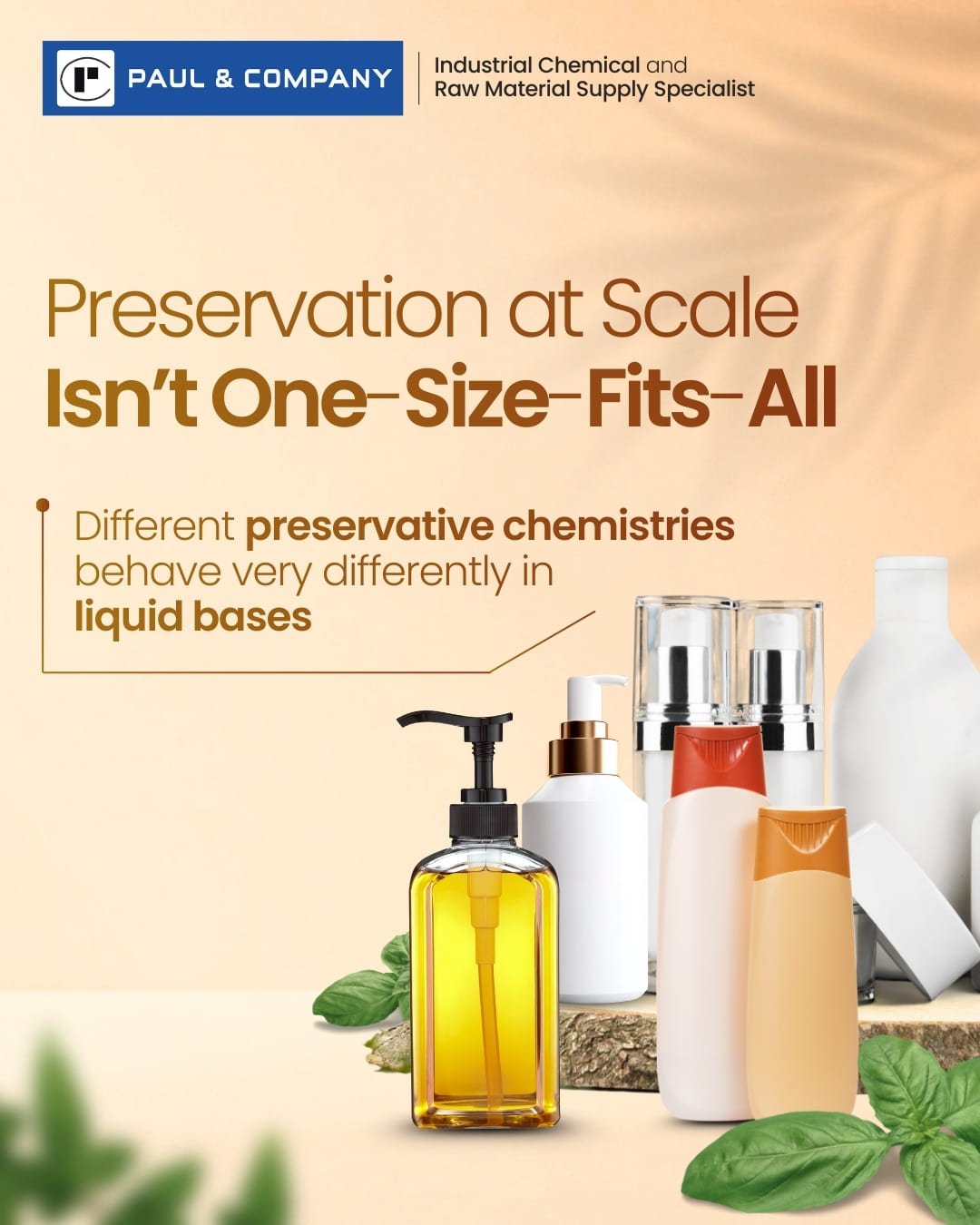
Preservatives in liquid personal care bases are often treated as a checkbox. 🔍
Parabens. Phenoxyethanol. Organic acids. Glycols. Alcohol-based systems but they don’t protect liquid bases the same way once you scale manufacturing.
Based on their chemistry, different classes of preservatives work differently.
And that difference shows up as:
– Product spoilage during storage 🗑️
– Microbial contamination during bulk handling 🦠
– Reduced product efficacy over time ⏳
– Shorter-than-expected shelf life 📉
Because the preservative system you choose quietly decides:
– How stable your liquid base remains across storage and holding conditions
– Whether microbial risk stays controlled during bulk handling
– How much flexibility you retain in final formulation
– Whether shelf-life claims hold up beyond controlled testing
– How much stress your finished product formulation carries later
These aren’t minor formulation choices.
They’re quality, safety, and brand-risk decisions.
Here’s what common preservative types actually do in liquid bases:
* Parabens — Broad-spectrum, highly effective protection with long-term stability
* Phenoxyethanol — pH-flexible, reliable backbone for many liquid systems
* Benzyl Alcohol — Mild antimicrobial support, commonly used in blends
* Formaldehyde Releasers — Strong microbial control, now declining due to perception and regulation.
* Benzoic Acid — Effective against yeast and mould in acidic systems
* Sorbic Acid — Targeted fungal protection within specific pH ranges
* Sodium Benzoate — Water-soluble option suited for aqueous liquid bases
* Potassium Sorbate — Yeast and mould control, highly pH-dependent
* Caprylyl Glycol — Multifunctional support with preservation and sensory benefits
* Ethylhexylglycerin — Preservative booster that improves overall system efficiency
* Natural / Nature-Identical Blends — Chosen where mildness and label perception matter, requiring tighter control
So before locking your preservative system, ask:
1️⃣ What microbial risk does your liquid base face before it becomes a finished product?
2️⃣ How will storage, transport, and climate exposure affect stability?
3️⃣ Are actives or botanicals placing additional stress on the system?
4️⃣ Is your preservative supporting scale — or limiting it?
5️⃣ Are claims driving decisions, or is performance?
Because in liquid bases, preservation isn’t about ingredients.
It’s about control — and delivering consistent product performance at scale.
At Paul & Company, we’ve supplied lakhs of kilograms of raw materials to manufacturers across India — and continue to do so, backed by 60+ years of industry trust.🏆